
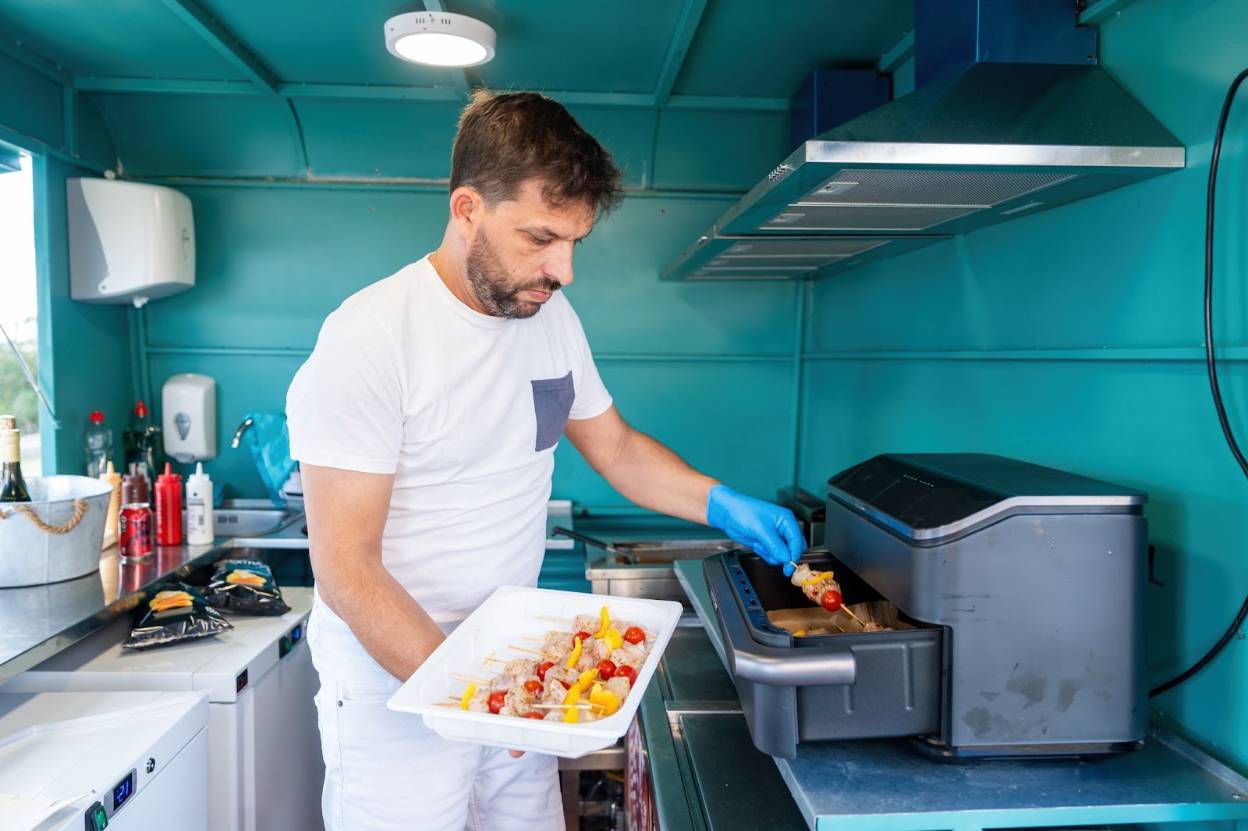
Mobile food vending has grown significantly across Canada over the past decade. Food trucks, market stalls, pop-up kiosks, and catering trailers now operate at festivals, farmers’ markets, street corners, and private events in every province and territory. With that growth comes regulatory scrutiny, and health authorities across the country have made it clear: mobile food premises must be held to the same food safety standards as fixed restaurants.
If you operate a mobile food business or work as a food handler within one, this article covers the key food safety risks, the requirements of Canadian regulations, and how certification supports compliance.
Food Safety Risks That Are Specific to Mobile Food Operations
Operating a mobile food premises introduces risks that fixed establishments do not face to the same degree. Compact working environments, variable access to utilities, and frequent location changes create conditions where food safety protocols can break down quickly.
Temperature Control
Limited refrigeration capacity and power fluctuations during transit increase the likelihood of food entering the temperature danger zone, between 4°C and 60°C, where pathogens multiply rapidly. Mobile operators need to monitor both hot and cold holding temperatures throughout every service period, not just at setup.
Cross-Contamination
When raw proteins and ready-to-eat foods share limited counter and storage space, the margin for error is narrow. Separate cutting boards, strict storage hierarchies, and regular sanitization of all food contact surfaces are daily requirements in a mobile unit.
Handwashing
Some mobile units operate with a single handwashing station that can become obstructed during peak service. Water tank capacity limits how often staff can properly wash their hands. Hand sanitizer is not a substitute for handwashing under Canadian food safety regulations.
Water Supply, Waste Management, Pest Control, and Storage
Each of these areas carries its own requirements. British Columbia’s provincial guidelines, for example, require separate potable water and wastewater tanks with readable gauges. Food must be stored in sealed containers, off the floor, and away from potential entry points. Sanitation plans must specifically address tank cleaning.
Managing all of this consistently requires food handlers who understand why each practice matters, not just that it is required.
The SafeCheck® Advanced Food Safety course teaches food handlers how to identify and manage these risks, including temperature control, cross-contamination, handwashing protocols, and sanitation planning.
Food Safety Regulations That Apply to Mobile Food Vendors Across Canada
Food safety regulations for mobile food premises operate at the federal, provincial, and municipal levels, and all three apply to mobile operators.
Federal Requirements
The CFIA enforces the standards set out in the Safe Food for Canadians Regulations. Mobile processing units that manufacture, process, treat, or package food for interprovincial trade or export require a federal licence.
Provincial Requirements
Provincial health authorities regulate day-to-day operations more directly. Across Canada, those regulations consistently require a valid operating permit, a written Food Safety Plan on-site during all hours of operation, a written Sanitation Plan, temperature logs for units storing or selling potentially hazardous foods, and at least one certified food handler on-site at all times.
Municipal Requirements
Municipal bylaws can add requirements on top of provincial legislation. Winnipeg requires the certificate to be posted visibly on-site. Toronto requires proof of a health inspection before issuing a mobile vending permit.
Mobile vendors who operate across multiple jurisdictions need a certificate from a nationally recognized, provincially approved provider to ensure compliance wherever they operate.
The SafeCheck® Advanced Food Safety (Handler) Certification is approved by provincial health departments in all Canadian provinces and territories, making it a reliable credential for mobile vendors operating across multiple regions.
Who Needs Food Handler Certification in a Mobile Food Operation
Operators and Staff
Food Handler Certification is required for anyone who prepares, handles, cooks, serves, or stores food in a mobile commercial food setting. This includes the operator, full-time and part-time staff, and seasonal workers. Many mobile operators certify their entire team to ensure continuous coverage across all shifts and event dates, rather than relying on a single certificate holder.
Health Inspections
Health inspectors may ask to see Food Handler Certification documentation during inspections. British Columbia’s Mobile Food Premises Guidelines list food handler training as a named inspection component. Wellington-Dufferin-Guelph Public Health in Ontario explicitly requires current Food Handler Certification documentation before a mobile food premises inspection proceeds.
Event and Contract Requirements
Beyond regulatory compliance, event organizers, festival coordinators, and private catering clients routinely require proof of food safety certification before approving vendor applications.
The SafeCheck® Advanced Food Safety course can be completed in as few as six hours, with unlimited exam attempts at no extra cost. Certification is valid for five years and recognized by health authorities across Canada.
Frequently Asked Questions
Do mobile food vendors in Canada need a food handler certificate?
Yes. In all Canadian provinces and territories, at least one certified food handler must be on-site at all times when food is being prepared or served. This applies to food trucks, market stalls, catering trailers, and pop-up kiosks. Municipal bylaws can add requirements on top of provincial legislation, so vendors should confirm specifics with their local public health unit.
What is the best food safety course for mobile food vendors in Canada?
The SafeCheck® Advanced Food Safety course offered by SafeCheck® Learning is a strong option for mobile food vendors. It is approved by provincial health departments across all Canadian provinces and territories, meaning the certificate is accepted by health units nationwide regardless of where a vendor operates. The course covers the food safety topics most relevant to mobile operations, including temperature control, cross-contamination prevention, sanitation planning, HACCP principles, and Canadian food safety laws and inspection requirements. It can be completed in as few as six hours, is fully self-paced with 24/7 access, and includes unlimited exam attempts at no additional cost. Certification is valid for five years from the date of issue.
Is a food handler certification valid across all provinces?
A certificate from a nationally recognized, provincially approved provider is accepted by health units across Canada. The SafeCheck® Advanced Food Safety Certification is approved in all provinces and territories.
What documents does a mobile food vendor need on-site during operation?
At minimum: a valid operating permit, a written Food Safety Plan, a written Sanitation Plan, and Food Handler Certification documentation. Temperature logs are also required if potentially hazardous foods are stored or sold on the premises.
How long does it take to complete the SafeCheck® course?
Most participants complete the course and exam in as few as six hours. The course is self-paced, with 24/7 access on any device with an internet connection, including video and audio.
What score is needed to pass the food handler certification exam?
A minimum score of 70% is required. The SafeCheck® program includes unlimited exam attempts at no additional cost.
How long is the Safecheck® Learning certification valid?
The SafeCheck® Advanced Food Safety Certification is valid for five years from the date of issue and is recognized across all Canadian provinces and territories.
Can part-time or seasonal staff get certified?
Yes. The SafeCheck® Advanced Food Safety course has no prerequisites and is open to anyone working in or preparing to enter a food service role, including part-time and seasonal staff.
Discover More Safety Blogs

Do You Need Food Handler Training for a Cottage Food Business?
Running a cottage food business means you’re responsible for safe food handling, even if you’re producing in small batches. While...
Read More
A Step-By-Step Guide to the Food Handler Course Renewal Process
In many provinces and territories, food service operations are expected to have at least one trained or certified food handler...
Read More
The Importance of Food Safety Training
Food safety training is an essential part of preparing food that’s safe to consume. Many food businesses don’t prioritize food...
Read More
CONTACT US
SafeCheck Learning & Canadian Food Safety